
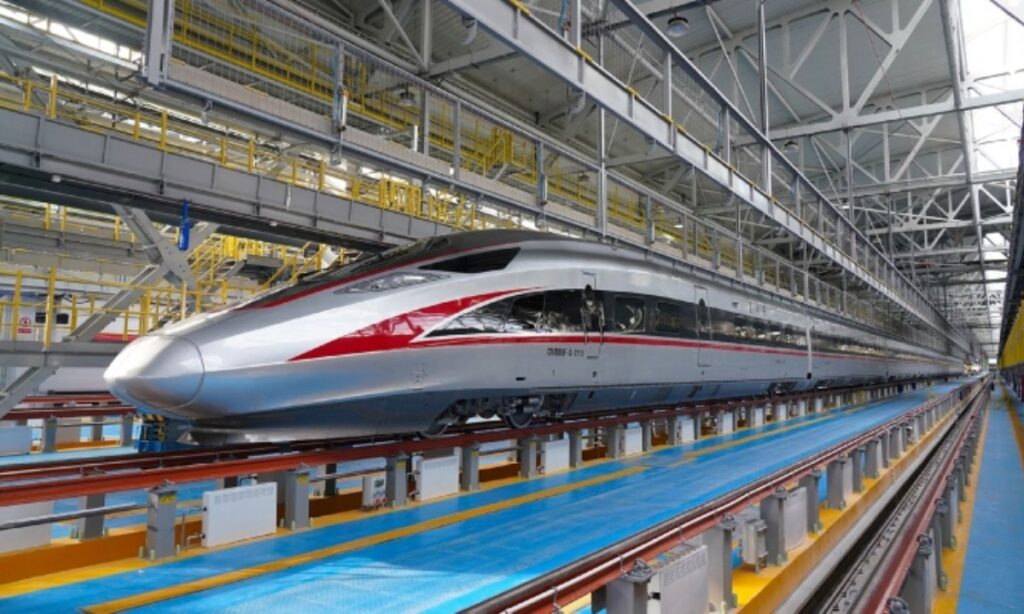
China has achieved another major breakthrough in high-speed maglev technology after an experimental vehicle accelerated from zero to 800 kilometres per hour in just 5.3 seconds.
The test was conducted on a 1-kilometre high-speed maglev track at Donghu Laboratory in central China’s Hubei province. The 1.1-tonne test vehicle reached its peak speed in roughly 600 metres before completing the run and coming to a controlled stop.
The latest achievement marks another world record for short-distance maglev acceleration. Researchers have previously demonstrated speeds of 650 km/h and 700 km/h on the same experimental platform, highlighting the rapid pace of development.
Unlike conventional trains, maglev systems use electromagnetic forces to levitate and propel vehicles, significantly reducing mechanical friction. The Hubei test platform combines magnetic levitation with electromagnetic propulsion and was designed to address challenges including high-speed stability, precise linear-motor control and low-latency communications.
Researchers also demonstrated controlled braking at the extreme speed, an important part of testing the technology for future high-speed applications.
However, the 800 km/h figure represents an experimental test speed rather than a passenger-service speed. China’s current commercial maglev operations run at substantially lower speeds.
The experimental platform is intended to support research into next-generation high-speed maglev transportation as well as electromagnetic launch technologies for aerospace applications.
The breakthrough underscores China’s continued push to develop ultra-high-speed transportation systems that could eventually dramatically reduce travel times between major cities.