
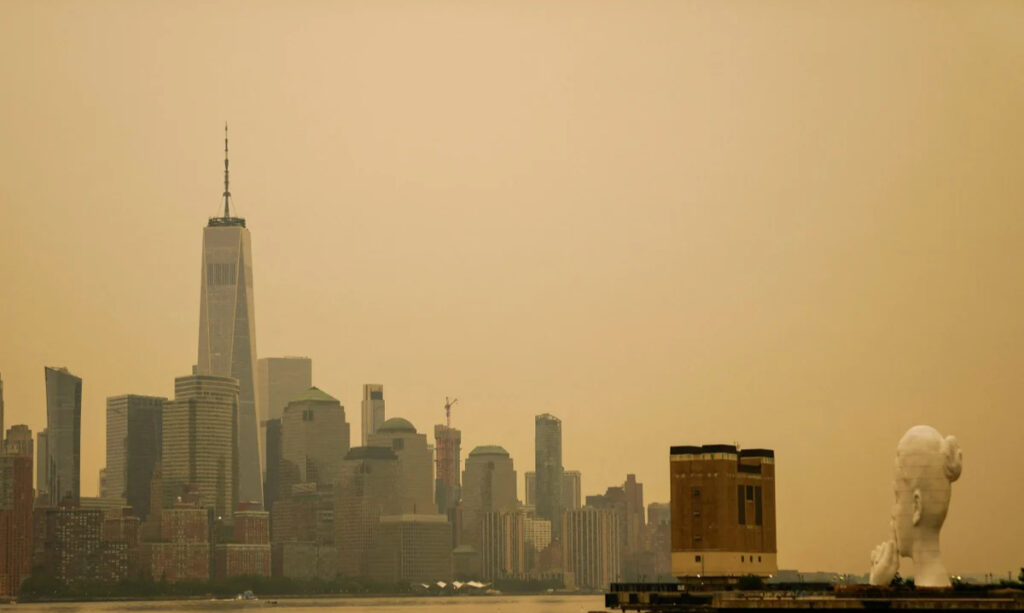
Smoke from hundreds of wildfires burning across Canada spread deep into the United States this week, triggering dangerous air quality levels in several major cities and prompting health officials to urge residents to limit outdoor activities.
Parts of the Northeast and Midwest remained covered in thick smoke and haze on Thursday while also enduring intense summer heat. Air Quality Index (AQI) readings exceeded 500 in cities including Toledo, Milwaukee, and Detroit—well above the hazardous threshold of 300 and among the worst air quality levels recorded this year.
Health experts warned that exposure to such polluted air can cause shortness of breath, throat irritation, burning eyes, headaches, dizziness, and fatigue, particularly among children, older adults, and people with respiratory or heart conditions.
Dr. Jonathan M. Tan of Children’s Hospital of Philadelphia told AccuWeather that spending a full day outdoors when the AQI exceeds 150 can expose a person to pollution comparable to smoking seven to nine cigarettes.
Authorities advised residents in affected areas to remain indoors whenever possible, avoid strenuous outdoor exercise, and wear well-fitted N95 masks if they must go outside.
Although air quality improved slightly in some regions on Friday, forecasters warned that changing wind patterns could carry additional wildfire smoke into parts of the Northeast over the weekend. The National Weather Service said smoke from Canada would remain “a concern this weekend” as northwesterly winds continue transporting polluted air into the northeastern United States.
Toledo’s AQI remained above 300 on Friday before forecasts projected a gradual improvement to the 100-200 range by Saturday—levels still considered unhealthy to very unhealthy. Similar conditions are expected to persist through the weekend in Detroit and Milwaukee.
New York City experienced its worst smoke on Thursday, with AQI levels approaching 200. While conditions improved somewhat on Friday, meteorologists warned that another wave of smoke could reduce air quality again on Saturday before cleaner air arrives on Sunday.
Washington, D.C., also recorded AQI readings near 200 on Friday, with unhealthy air expected to linger into Saturday before gradually clearing by the start of next week.