
The Pakistan Meteorological Department (PMD) has issued a fresh Glacial Lake Outburst Flood (GLOF) alert for Gilgit-Baltistan (GB) and Khyber Pakhtunkhwa (KP), warning that rising temperatures and intermittent rainfall are likely to increase the risk of flash floods, landslides, and glacial lake bursts through the first week of August.
The warning extends an earlier advisory issued on July 17, with the Met Office saying that the combined impact of an unusually warm weather pattern and ongoing rainfall is accelerating snow and glacier melt across the country’s northern mountainous regions.
According to the PMD, the continued warming is expected to significantly raise water levels in rivers and streams, expand existing glacial lakes, and potentially create new ones due to the increased volume of meltwater.
“The rapid expansion of glacial lakes can destabilise their natural ice and moraine dams, potentially triggering Glacial Lake Outburst Flood (GLOF) incidents,” the department warned.
Authorities cautioned that downstream communities and low-lying areas near rivers and streams face a heightened risk of sudden flooding, while narrow valleys remain vulnerable to flash floods and debris flows.
The PMD also warned that thawing permafrost, combined with excess surface water, could trigger heavy mudslides and increase the likelihood of landslides in steep mountainous terrain.
Pakistan is home to more than 13,000 glaciers, the largest concentration outside the polar regions. However, climate experts warn that thousands of glaciers in Gilgit-Baltistan and Chitral are retreating due to rising temperatures linked to climate change, increasing the frequency of dangerous GLOF events.
The Ministry of Climate Change estimates that over 7.1 million people living in GB and KP are vulnerable to glacial lake outburst floods.
The PMD has advised residents to stay away from riverbanks, streams, glacial lakes, and mountain nullahs, avoid camping or trekking in vulnerable areas, and remain in close contact with local disaster management authorities for updates and emergency guidance.
Disaster management agencies have also been directed to remain on 24-hour alert and take precautionary measures to minimise risks.
Roads Still Blocked in Gilgit-Baltistan
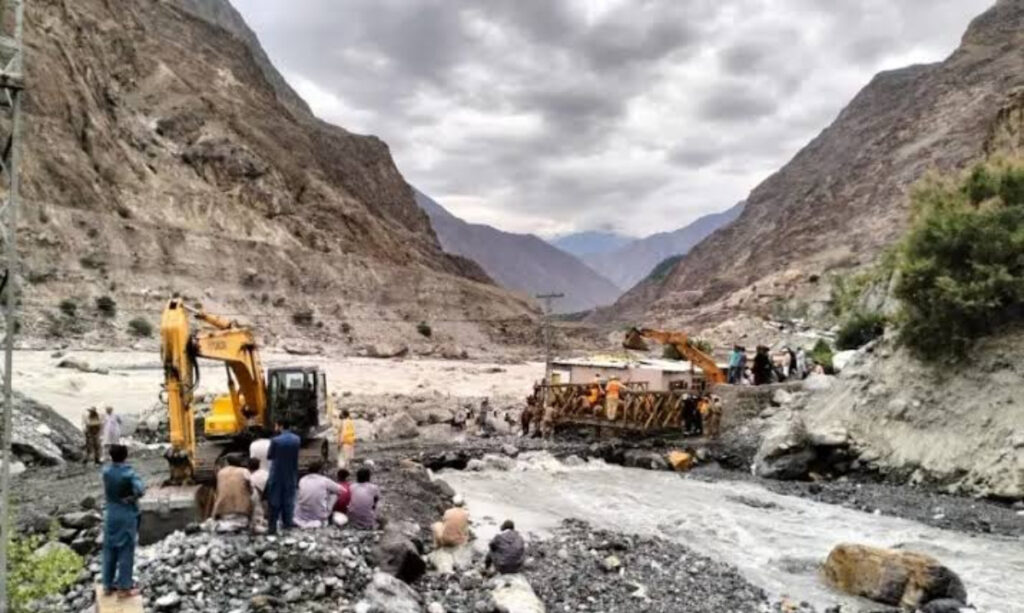
Meanwhile, transportation across several parts of Gilgit-Baltistan remains severely disrupted as flash floods and GLOF incidents continue to damage critical road infrastructure.
Authorities are installing a temporary iron bridge on the Baltistan Highway to restore traffic after floodwaters washed away sections of the route. Road access to multiple areas has remained cut off for the fifth consecutive day, leaving commuters stranded and slowing relief and rehabilitation efforts.
The flooding, driven by extreme heat and accelerated glacier melt, has also hampered restoration work, with officials racing to reconnect isolated communities before further rainfall is expected.