
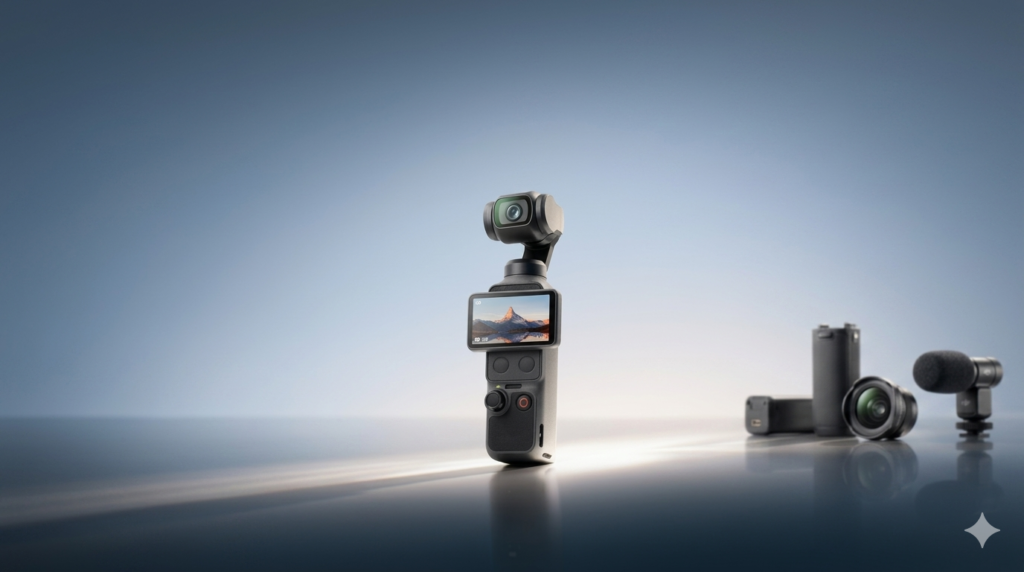
After months of rumours, the DJI Osmo Pocket 4 has finally arrived to take the place of the best-selling Pocket 3 vlogging camera. I expect it to be just as popular.
The Pocket 4 isn’t a tremendous upgrade, but it does appear like a better vlogging camera than the Pocket 3. It might be worth trading in the Pocket 3 for it. This article talks about the seven most important changes in the newest model.
Both of these models are worth checking out if you’re looking for your first vlogging camera. I filmed a lot of things with the Pocket 4 before it came out—look for my full review soon—and I’ve been using its predecessor for the last two years. Both are great alternatives to smartphones for video because they have a very small and discreet body and can shoot 4K video with gimbal stabilisation and the tools needed for clear vocals, especially when using DJI’s own wireless mics.
The Essential Combo for the Pocket 4 costs £429 / AU$749, and the Creator Combo costs £549 / AU$949. The Creator Combo comes with a battery handle, a wireless mic, and a new magnetic fill light, among other things. At launch, there are no US prices or availability.
Let’s get right to the point and look at the main differences between the DJI Osmo Pocket 4 and Pocket 3.
The spec sheet doesn’t show much change in image quality. The Pocket 4 has a 1-inch sensor and can capture 4K video, same like the Pocket 3. DJI, on the other hand, states that the sensor is new and that the 4K video output is optimised with 14 stops of dynamic range, which is increased by 2 stops in low light mode.
1. Video quality
In the Pro setting, you may additionally choose 10-bit colour depth and a new D-Log colour profile. Want a look that looks baked in? You can choose from six new film tones. The new DJI Mimo app also has a lot of new beauty filters if that’s something you like
2. In slow motion
One of the most exciting new features is 8x slow-motion filming in 4K, which is 240 frames per second, up from the Pocket 3’s 120 frames per second. Most other cameras that can record at such low frame rates, like the Pocket 3, only do so at 1080p. However, the newest model from DJI can record at similar frame rates in 4K as well. Just so you know, the 2x zoom feature (see below for more information) doesn’t operate in this mode.
3. Keeping track of subjects
The Pocket 4 has DJI’s next-generation Active Track 7.0, which is the best subject tracking I’ve ever seen. Just double-tap your subject, and the Pocket 4 will keep them in the middle of the frame. It works with people, cars, dogs, and more.
The Pocket 3’s Active Track 6.0 function doesn’t work with subject tracking, however it does work in photo mode, with the 2x lossless zoom, and with the D-Log colour profile.
4. Skills with a camera
The Pocket 4 features a higher photo resolution than the Pocket 3, going from 9.4 megapixels to 37 megapixels. You can get more detailed pictures by choosing the SuperPhoto option. The 1:1 aspect ratio stills will have the highest resolution, but the 16:9 format will have a lower resolution of 33 megapixels. In ordinary photo mode, the resolution is still about the same as previously, which is about 4K.
You can take pictures in JPEG or RAW format, or both at the same time. The 2x lossless zoom can now be utilised in photo mode and when current track is playing. The Pocket 3 does not have this feature.
5. Rules
The Pocket 4 has several nice design changes that make it less measurable on a spec sheet but much more useful in real life.
The joystick that controls the camera’s gimbal has been improved, and the speed at which it moves changes based on how hard you press it. When the screen is horizontal, you can see two new buttons under it. These buttons give you quick access to key functions like zoom.
The gimbal arm now incorporates electronic contacts and a magnetic surface. You can use these to connect a new magnetic fill light accessory that comes with the Creator Combo package. The camera powers the light, and it doesn’t throw out much light. It’s only useful in dark places or at night, but it’s a nice bonus.
6. How long the battery lasts
The Pocket 4 boasts a bigger battery than the Pocket 3, with a capacity of 1,545mAh. That’s 20% more energy than the Pocket 3’s 1,300mAh battery. The Pocket 4 has been tested to run for up to 4 hours with this upgraded battery pack while capturing 1080p video at 24 frames per second, with wireless connectivity, and with the screen switched off. The time it takes to record in 4K will be much shorter.
The time it takes to charge has also gone down. The Pocket 4 can get a full charge in 32 minutes or an 80% charge in just 18 minutes with DJI’s 65W PD charger (sold separately). We don’t have the data for charging with a normal USB-C cable.
7. Remember
The Pocket 4 has 107GB of built-in storage, which is enough for many hours of 4K video files. The Pocket 3 does not have any. Both can save data to a micro SD card. Oh, and thank God, DJI has added a door to protect the micro SD card slot, which is completely open in the Pocket 3.
The Pocket 4 also has next-gen Wi-Fi 6 and USB 3.1 connectivity, as well as better wired transfer speeds, which makes it easier to work on the go.
There are a few more functions in the Pocket 4, but those seven are the most important ones. It feels like a better vlogging camera all around.