
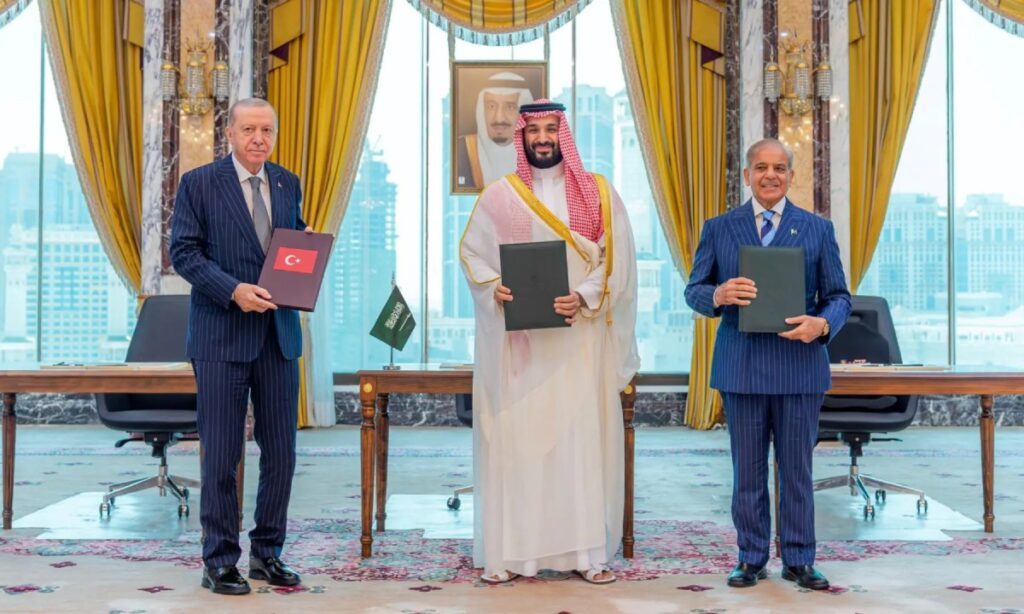
Pakistan, Saudi Arabia and Türkiye have signed a landmark joint defence agreement in Makkah, committing to regard an armed attack against any one of the three countries as an attack against all.
The Makkah Joint Defence Agreement was signed on Friday at Al-Safa Palace by Prime Minister Shehbaz Sharif, Saudi Crown Prince and Prime Minister Mohammed bin Salman, and Turkish President Recep Tayyip Erdogan during the Makkah Al-Mukarramah Summit for Joint Defence.
According to a joint statement issued by the three countries, the agreement is aimed at strengthening collective security, enhancing deterrence against aggression and promoting peace and stability in the region and beyond.
“The agreement is intended to strengthen collective deterrence against any act of aggression,” the statement said, adding that “any armed attack against any one of the three states shall be regarded as an attack against them all.”
The pact also provides for enhanced cooperation across defence-related areas and builds on the longstanding military and strategic ties between Pakistan, Saudi Arabia and Türkiye.
The signing brings together three strategically important Muslim-majority states: Pakistan, a nuclear-armed country; Saudi Arabia, the world’s leading oil exporters and home to Islam’s two holiest sites; and Türkiye, a NATO member with one of the region’s largest military forces.
Pakistan’s Chief of Defence Forces and Chief of Army Staff Field Marshal Asim Munir, Deputy Prime Minister and Foreign Minister Ishaq Dar, and Defence Minister Khawaja Asif attended the signing ceremony. Defence and foreign ministers from Saudi Arabia and Türkiye were also present.
The agreement comes amid heightened security tensions across the Middle East and marks a significant expansion of trilateral defence cooperation. The pact has been described as a major step toward greater regional collective deterrence, although the three countries have stressed its defensive purpose.
Why it matters
The agreement creates a formal framework linking the defence interests of Pakistan, Saudi Arabia and Türkiye. It could lead to deeper military coordination, defence technology cooperation, intelligence-sharing and joint preparedness, while giving the three countries a stronger collective security posture in a rapidly changing regional environment.